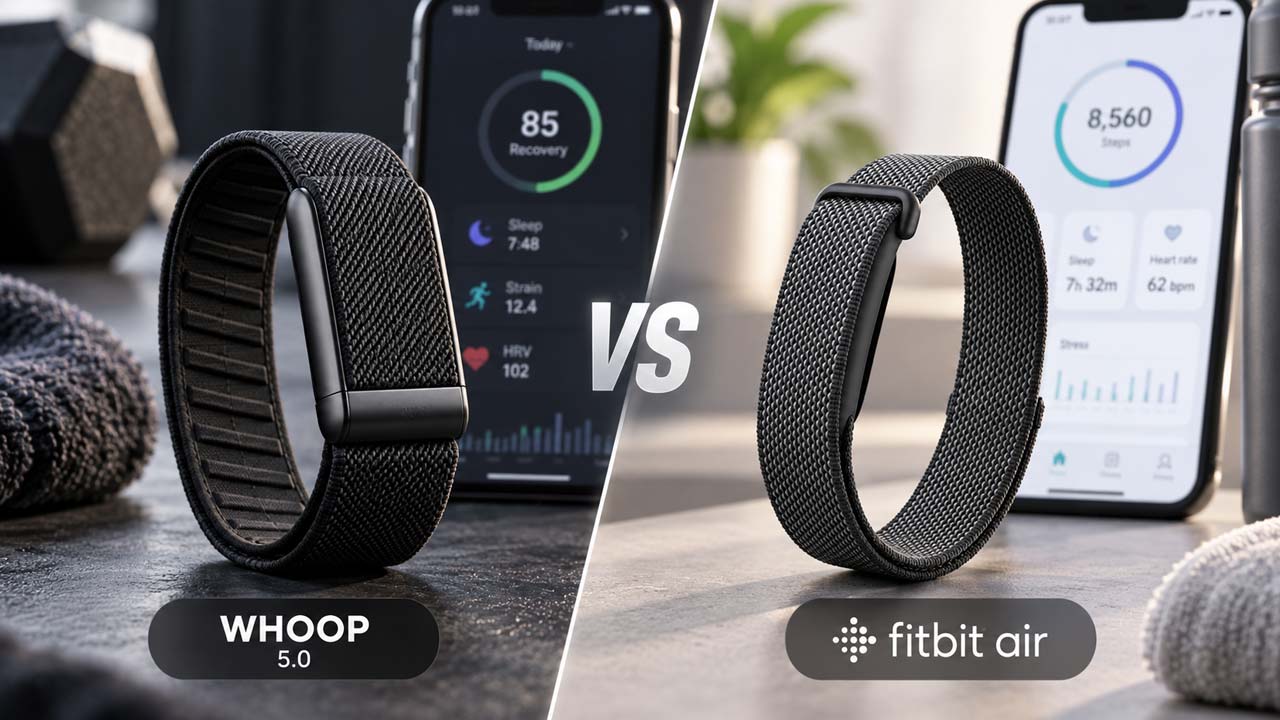
The screen-free fitness tracker category has become a lot more interesting in 2026.
WHOOP has spent years building its reputation around recovery, sleep, training load, and personalized coaching, but Google has now entered the space with the Fitbit Air.
At first glance, the two devices look remarkably similar. Both are tiny, screenless wearables designed to disappear into the background while continuously collecting health and fitness data.
Neither is designed to replace a smartwatch, and both encourage users to check their metrics through a smartphone app rather than on their wrist. But the similarities largely end there.
The Fitbit Air starts at $99 and offers core tracking without requiring a subscription, while WHOOP is built around a membership model that starts at $199 per year.
WHOOP 5.0 also focuses much more heavily on athletic performance, recovery, and training analysis, whereas Fitbit Air takes a broader approach to everyday health and fitness.
So, which one should you buy? Here’s how WHOOP and Fitbit Air compare across design, sensors, health tracking, sleep, workouts, recovery, battery life, subscriptions, and overall value.
WHOOP vs Fitbit Air: Quick Comparison
| Feature | Fitbit Air | WHOOP 5.0 |
|---|---|---|
| Design | Screenless tracker | Screenless tracker |
| Starting hardware price | $99.99 | Included with membership |
| Subscription | Optional for advanced features | Required |
| Battery life | Up to 7 days | 14+ days |
| Weight | Around 5.2g without band | Around 26.5g without band |
| Heart-rate tracking | Yes | Yes |
| SpO2 | Yes | Yes |
| Skin temperature | Yes | Yes |
| Sleep tracking | Yes | Yes |
| Recovery tracking | Yes | Yes |
| Workout tracking | Yes | Yes |
| Automatic workout detection | Yes | Yes |
| GPS | No built-in GPS | No built-in GPS |
| Phone compatibility | Android and iOS | Android and iOS |
| Water resistance | 50 meters | 10 meters |
| ECG | No | Available on WHOOP MG |
| AI/personalized coaching | Google Health Coach with Premium | WHOOP coaching |
| Main focus | Everyday health and fitness | Performance, recovery and training |
The hardware specifications already reveal the biggest difference between the products.
Fitbit Air is much lighter and cheaper, while WHOOP offers longer battery life and a considerably deeper performance-focused ecosystem.
Design and Comfort
Both Fitbit Air and WHOOP 5.0 follow the same basic philosophy: remove the screen and let the wearable quietly collect data throughout the day.
The Fitbit Air is small and lightweight. The tracker itself weighs around 5.2 grams without its band, so it’s easy to forget that you’re wearing it.
Google designed the Air specifically for continuous health monitoring, with a small sensor module that sits discreetly against the skin.
WHOOP 5.0 takes a slightly different approach. It is still screenless and designed for 24/7 wear, but the device is larger and heavier than Fitbit Air.
WHOOP also offers a much wider ecosystem of bands, accessories, and Body apparel, so you can wear the sensor in different locations rather than keeping it exclusively on the wrist.
For someone who wants the smallest possible tracker, Fitbit Air has a clear advantage.
WHOOP, however, is more flexible if you’re serious about training and don’t always want a sensor on your wrist.
Health and Fitness Tracking
This is where the two devices start to separate.
Fitbit Air tracks heart rate, blood oxygen, skin temperature, and movement, while also providing sleep and fitness insights through the Google Health ecosystem.
It can automatically detect workouts and continuously collect health information without requiring the user to interact with the device.
WHOOP 5.0 is much more aggressively focused on turning raw measurements into performance metrics.
WHOOP tracks Strain, Recovery, and Sleep and also has features such as VO2 Max, heart-rate zones, and support for more than 145 activities.
Fitbit Air gives you a general idea about: “How am I doing overall?” WHOOP is much more focused on: “How hard did I train, how well did I recover, and what should I do next?”
For general health tracking, Fitbit Air covers the fundamentals. For athletes and people who train regularly, WHOOP’s interpretation of the data is considerably more extensive.
Sleep Tracking
Sleep is a major part of both ecosystems.
Fitbit has been involved in sleep tracking for years, and Fitbit Air brings sleep monitoring into its screen-free form factor.
The device can track sleep throughout the night and provide information about sleep quality and trends through the Google Health app.
WHOOP, meanwhile, treats sleep as one of the three pillars of its ecosystem alongside Strain and Recovery.
WHOOP’s approach goes beyond simply showing how long you slept. Its system uses sleep and previous activity data to determine recovery and help establish recommendations for future training.
This makes WHOOP more interesting for people who want their sleep data to influence their training decisions.
For someone who simply wants to know whether they are sleeping enough and see longer-term trends, Fitbit Air should be enough.
Recovery Tracking
Recovery data is the biggest reason to buy a WHOOP.
WHOOP’s Recovery score is central to its experience. The system looks at multiple physiological signals and uses them to provide an indication of how prepared your body is for activity.
This is then combined with Strain and Sleep to create a broader picture of training load and recovery.
Fitbit Air also provides recovery-related recommendations, but its approach is more general-purpose.
This means the difference isn’t necessarily that one device can track recovery and the other cannot. The difference is how deeply recovery is integrated into the entire ecosystem.
WHOOP essentially builds the product around recovery. Fitbit Air treats recovery as one component of a larger health-tracking platform.
For serious athletes, the choice is very clear.
Workout and Training Features
WHOOP is designed with athletes in mind. The platform supports more than 145 activities and provides detailed information about training load, heart-rate zones, and Strain.
WHOOP’s newer hardware also captures sensor data at a high frequency and generates more detailed performance insights.
Fitbit Air can automatically detect workouts and track fitness activity, but it isn’t trying to compete directly with a dedicated sports watch.
Another important limitation of both devices is that neither has built-in GPS.
For location-based workout information such as routes and outdoor distance, the phone remains important. The Fitbit Air, in particular, relies on a paired smartphone for location tracking.
If you’re a runner, cyclist, or outdoor athlete who wants maps and real-time workout information, neither device should be viewed as a complete replacement for a GPS sports watch.
Battery Life
Battery life is one area where WHOOP has a clear lead.
Fitbit Air owners are getting around six to seven days, while others have reported only three to four days.
WHOOP 5.0 is considerably stronger here. Many WHOOP 5.0 owners report around two weeks of use, with some even claiming significantly longer battery life.
That means WHOOP’s advertised 14+ days is a reasonable real-world expectation for many users, but it isn’t guaranteed for every unit or usage pattern.
The practical takeaway is simple: expect roughly a week from Fitbit Air and roughly two weeks from WHOOP 5.0, with individual results varying.
Charging is another advantage for WHOOP. Its PowerPack can charge the tracker while it remains on the wrist, which means you don’t necessarily have to create a gap in your sleep or activity data.
Fitbit Air needs to be removed for charging, although its roughly 90-minute full-charge time is reasonably quick.
WHOOP’s battery system is overall better and more convenient.
Fitbit Air vs WHOOP Subscription
This is probably the biggest difference between the two products.
Fitbit Air costs $99.99, and many of its core health and fitness features are available without an ongoing subscription.
Google does offer Google Health Premium for users who want additional AI-powered insights and more advanced features. Fitbit Air also launched with a three-month Premium trial.
WHOOP works differently. The WHOOP experience is built around a membership.
WHOOP currently has One at $199 per year, Peak at $239 per year, and Life at $359 per year.
The different tiers provide access to different levels of health, fitness, and longevity features, with WHOOP 5.0 or MG hardware included as part of the membership offering.
That makes the long-term cost difference substantial. A Fitbit Air is something you can buy once and use for core tracking without committing to another annual payment.
WHOOP is effectively a subscription service that happens to come with a wearable.
WHOOP’s Biggest Advantage: The Ecosystem
The biggest strength of WHOOP isn’t the physical tracker. It’s the software ecosystem surrounding it.
WHOOP takes data from sleep, heart rate, activity, and training and turns it into a collection of metrics designed to help users understand their physical readiness.
The platform is particularly attractive to people who enjoy analyzing training performance and changing their behavior based on recovery data.
WHOOP also has a strong focus on coaching. Its membership includes personalized coaching designed to help you understand your data rather than simply displaying raw numbers.
Fitbit’s advantage is that it doesn’t demand the same level of commitment.
The Google Health ecosystem is broader and more approachable, making Fitbit Air a better fit for people who want health information without turning their entire lifestyle into a collection of performance metrics.
Fitbit Air’s Biggest Advantage: Value
At $99.99, Fitbit Air dramatically lowers the barrier to entering the screenless tracker category.
That’s important because WHOOP’s annual membership starts at $199. Even if WHOOP offers more sophisticated performance analysis, you’re paying considerably more for access to it.
Fitbit Air also has an advantage for people who already use Google’s ecosystem. The tracker integrates with the Google Health app and can coexist with other Fitbit and Pixel devices, so it’s easier to keep health information in one place.
That’s why Fitbit Air is much easier to recommend to someone who simply wants passive health tracking.
WHOOP vs Fitbit Air: Which Has Better Sensors?
On paper, the two devices are surprisingly close.
Both offer heart-rate monitoring, SpO2, skin-temperature tracking, accelerometer, and gyroscope sensors.
WHOOP’s newer hardware, however, is designed to capture substantially more sensor data and feed that information into its performance-focused algorithms.
WHOOP also offers a more advanced MG model with an ECG capability. That feature isn’t available on the standard Fitbit Air.
However, sensor count alone doesn’t determine which device provides better information. The software interpreting the data is just as important, and this is where WHOOP has spent years developing its performance ecosystem.
Water Resistance
Fitbit Air is rated for 50-meter water resistance, while WHOOP 5.0 is listed at 10 meters in the same comparison.
That makes the Fitbit Air particularly interesting for people who frequently expose their tracker to water.
WHOOP is less about maximum water depth and more about its overall 24/7-wear philosophy and accessory ecosystem.
Android and iPhone Compatibility
Neither device locks users into a single smartphone platform.
Fitbit Air works with both Android and iOS, while WHOOP also supports both platforms. This is better for you if you don’t want to switch phones just to use their wearable.
The more meaningful difference is the ecosystem behind the apps. Fitbit Air is closely tied to Google’s health platform, while WHOOP’s entire experience revolves around the WHOOP app and membership.
Who Should Buy Fitbit Air?
Fitbit Air makes the most sense if you want a small, comfortable fitness tracker without paying for an expensive smartwatch.
It’s particularly appealing if you want continuous heart-rate monitoring, sleep tracking, basic workout tracking, and everyday health insights while keeping the device completely distraction-free.
The $99.99 starting price is also a major advantage. Core tracking doesn’t require a subscription, while Google Health Premium is there if you want deeper AI-powered insights and coaching.
In other words, Fitbit Air is the more straightforward product. Buy it, wear it, sync it, and check your health information when you want.
Who Should Buy WHOOP?
WHOOP makes more sense for people who take training and recovery seriously.
If you regularly go to the gym, run, cycle, play competitive sports, or follow a structured training program, WHOOP’s focus on Strain, Recovery, Sleep, heart-rate zones, and training analysis can be significantly more useful than a basic activity tracker.
The same applies to people who enjoy analyzing data and adjusting their behavior based on what their wearable tells them.
The downside is the price. WHOOP’s membership model means you’re committing to a recurring cost rather than simply buying a tracker outright.
WHOOP vs Fitbit Air: Which Is Better?
There isn’t one universal winner because these two products are designed around different priorities.
Fitbit Air is the better choice for affordability, simplicity, and everyday health tracking. Its $99.99 price, lightweight design, seven-day battery, and subscription-free core features make it much easier to live with if you aren’t interested in advanced athletic analytics.
WHOOP is the better fit for performance-focused users. Its 14+ day battery, extensive training ecosystem, Recovery and Strain metrics, personalized coaching, and broader athletic analysis give it a much deeper focus on training and recovery.
The decision ultimately comes down to what you want from a screenless wearable.
If you want a tiny health tracker that quietly monitors your body without costing a fortune, Fitbit Air makes more sense.
If you want a dedicated training and recovery platform that happens to come with a wearable, WHOOP is the more appropriate choice.
For most casual users, the lower upfront price and lack of a mandatory subscription make Fitbit Air the simpler entry point.
For serious athletes and data-focused users, WHOOP’s deeper performance ecosystem is the main reason to pay the premium.