Smartphones have become faster, more powerful, and more sophisticated than ever.
Modern phones offer incredible cameras, brighter displays, faster charging, and years of software updates.
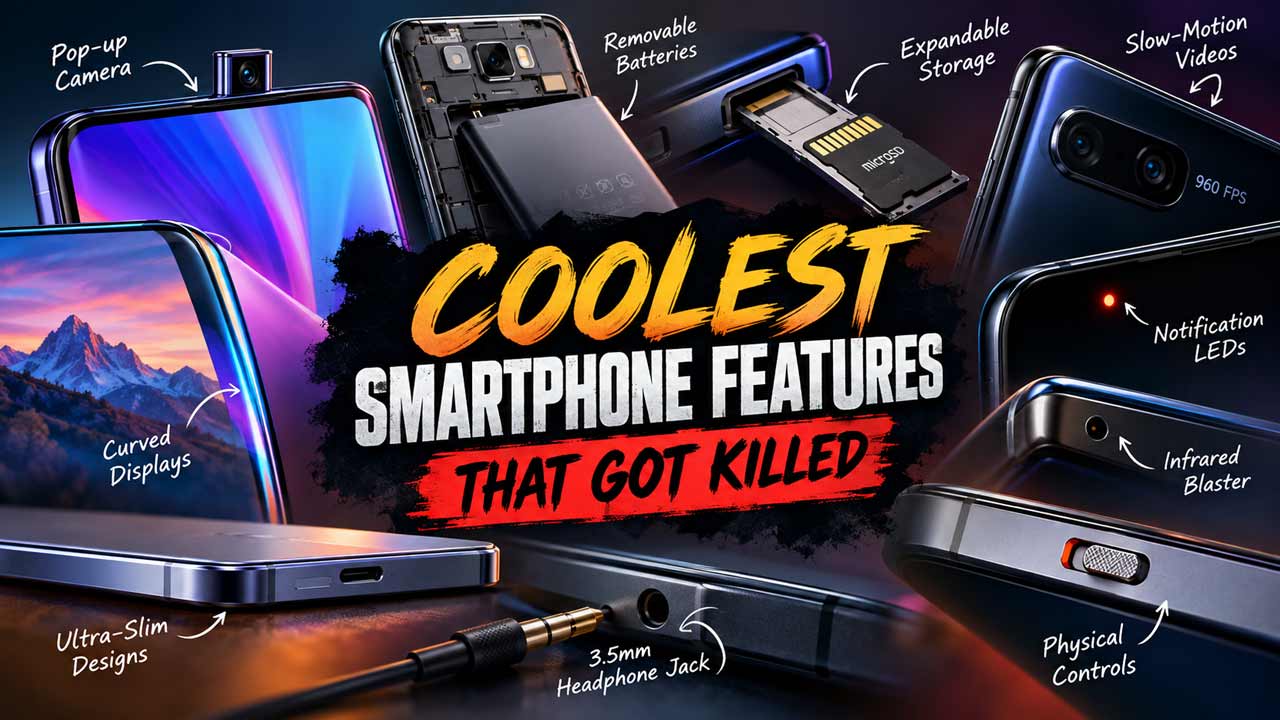
Yet, somewhere along the way, smartphone manufacturers also abandoned some genuinely interesting technologies that made older devices feel exciting and different.
Remember when phones had pop-up selfie cameras, futuristic curved displays, and designs so slim that they felt almost unreal? Or when manufacturers competed to introduce the most impressive slow-motion recording modes?
Those days brought plenty of experimentation, and not every idea survived the transition to modern smartphones.
The biggest irony is that some of these features were removed in the name of progress, even though many users still miss them.
Others were simply ahead of their time, while a few were replaced by technologies that were more practical for everyday use.
Here are some of the coolest smartphone technologies and features that have disappeared, become increasingly rare, or lost their place in the mainstream smartphone market.
1. Pop-Up Selfie Cameras
Pop-up selfie cameras were one of the most exciting smartphone innovations of the late 2010s.
At a time when manufacturers were trying to eliminate display notches and punch-hole cameras, this technology offered a clever alternative: hide the front camera inside the phone and reveal it only when needed.
Phones such as the OnePlus 7 Pro, Vivo NEX, and Redmi K20 Pro made the idea popular.
Opening the front camera app caused a motorized mechanism to rise from the top of the device, creating a genuinely futuristic experience.
The biggest advantage was an uninterrupted display. There were no notches, no punch holes, and no need to sacrifice screen space for a selfie camera.
Unfortunately, pop-up cameras came with compromises. Moving mechanical parts introduced potential failure points, while dust, water resistance, and the extra internal space required by the mechanism made the technology difficult to sustain.
Manufacturers eventually shifted toward simpler fixed cameras and punch-hole displays.
Pop-up cameras might not have been the most practical solution, but they made smartphones feel innovative in a way that today’s nearly identical front-camera designs rarely do.
2. Curved Displays That Wrapped Around the Edges
Curved displays were once the ultimate symbol of a premium smartphone.
Samsung helped popularize the design with the Galaxy S6 Edge and Galaxy S7 Edge, while later devices pushed the concept further with aggressively curved edges.
These displays made phones look futuristic, creating the illusion that the screen flowed over the sides of the device.
Some manufacturers even added edge panels, lighting effects, shortcuts, and notification features to take advantage of the extra screen area.
Eventually, however, the design became less appealing. Curved edges could cause accidental touches, make screen protectors harder to fit, increase repair costs, and introduce unwanted reflections.
They also made the edges of the display more vulnerable to damage. The industry has gradually moved toward flat displays or more subtle curves.
Although some phones still use curved glass, the dramatic edge displays that once defined premium Android smartphones have largely disappeared.
Curved displays were beautiful to look at, but their practical advantages never quite matched their futuristic appearance.
3. Ultra-Slim Smartphone Designs
There was a time when smartphone manufacturers competed to make their devices as thin as possible.
Every fraction of a millimeter mattered, and companies regularly advertised their phones’ thickness as a major selling point.
Devices such as the Oppo R5 and Vivo X5 Max became famous for their exceptionally slim bodies.
The iPhone 6 and other contemporary smartphones also reflected the industry’s obsession with thinness.
But this race came with trade-offs. Extremely thin phones had less room for batteries, larger camera sensors, effective cooling systems, and other hardware.
Some also suffered from compromises in battery life or structural rigidity.
Today, manufacturers prioritize battery capacity, camera performance, thermal management, and durability. Camera modules have also grown substantially, making it harder to create a truly thin phone without sacrificing something important.
The industry hasn’t abandoned slim phones altogether, but the obsession with achieving the thinnest possible design has largely faded from mainstream flagship marketing.
It has also reappeared in a different form through ultra-thin phone launches, showing that the idea itself isn’t completely dead.
4. Extreme Slow-Motion Video Recording
Slow-motion recording hasn’t disappeared from smartphones, but the race to deliver spectacular ultra-slow-motion modes has certainly lost momentum.
Sony, Samsung, and other manufacturers once made super-slow-motion recording a major selling point.
Phones such as the Sony Xperia XZ Premium and Samsung Galaxy S9 offered recording modes capable of capturing brief moments at around 960 frames per second under suitable conditions.
The results were fascinating. Water splashes, bursting balloons, flying insects, and sporting movements could be captured in extraordinary detail, turning everyday moments into dramatic video clips.
The catch was that these modes often came with limitations. Recording windows were short, lighting requirements were demanding, and resolution or image quality could suffer. Capturing the perfect moment also required good timing.
Modern smartphones continue to offer slow-motion video, and some deliver excellent results.
However, the emphasis has shifted toward high-quality 4K recording, computational video processing, stabilization, and better low-light performance rather than making extreme frame rates the headline feature.
The technology isn’t dead, but the excitement surrounding it has faded. It would be great to see manufacturers bring back dedicated, high-quality super-slow-motion modes with fewer restrictions.
5. The 3.5mm Headphone Jack
The headphone jack is one of the most controversial casualties of modern smartphone design.
For decades, plugging in a pair of wired headphones was a basic feature that users rarely had to think about.
That changed when manufacturers began removing the 3.5mm port from their flagship phones. Apple’s iPhone 7 was a major turning point in 2016, and other manufacturers gradually followed.
Companies argued that removing the port created more internal space, simplified the design, and helped with water resistance. Wireless earbuds also became popular because of that.
But the change came with real disadvantages. Wired headphones don’t need charging, don’t require Bluetooth pairing, and can connect to compatible devices instantly.
They are also useful for low-latency audio, recording equipment, and older car audio systems.
Some manufacturers, including Sony, continue to offer headphone jacks on selected smartphones, so the feature isn’t entirely extinct. However, it has become much harder to find on premium devices.
6. Removable Batteries
Removable batteries made smartphones far more convenient to own.
If the battery ran out, you could replace it with a fully charged spare in seconds. If the battery degraded after a few years, replacing it didn’t necessarily mean visiting a repair shop.
Phones such as the Samsung Galaxy S5 and LG V20 kept this practical design alive even as the industry moved toward sealed bodies.
The transition to non-removable batteries helped manufacturers create more tightly sealed phones, improve water resistance, and use internal space more efficiently.
Fast charging and power banks also reduced the need to carry spare batteries.
Still, a sealed battery creates an inconvenience when it eventually wears out. Replacing it can require tools, adhesives, and professional assistance, depending on the device.
The good news is that user-replaceable batteries are receiving renewed attention through repairability initiatives and regulations.
The traditional removable-back design may be rare, but easier battery replacement is an idea worth bringing back.
7. Expandable Storage Through microSD Cards
There was a time when buying a smartphone with limited internal storage wasn’t a major problem. You could simply insert a microSD card and expand the available space whenever you needed it.
This was useful for people who downloaded movies, stored large music libraries, recorded long videos, or installed numerous games. It also made transferring files between devices much easier.
Many older Samsung Galaxy flagships and other Android phones supported expandable storage.
Today, microSD slots are largely absent from premium phones, although they remain available on selected budget and midrange models.
Manufacturers rely on larger internal storage options and cloud services. Faster internal storage can also deliver better performance than many microSD cards.
However, the removal still leaves users with an expensive choice: pay more for a higher-storage variant or manage their files more carefully.
Cloud storage isn’t always convenient when internet access is limited, either.
Expandable storage wasn’t glamorous, but it was one of the most practical features smartphones ever offered.
8. Notification LEDs
A tiny blinking light might not sound impressive today, but notification LEDs were genuinely useful.
Older Android phones often included a small LED that changed color or blinked when a message arrived, the battery was charging, or a notification needed attention.
Depending on the phone and software, you could even assign different colors to different apps.
The best part was that you didn’t need to wake the display or pick up your phone to check whether something had happened.
As displays grew larger and bezels became thinner, manufacturers gradually removed these lights.
Always-on displays, edge lighting, and notification effects now provide some of the same functionality, but they don’t always replicate the simplicity of a dedicated LED.
This was a small feature with a surprisingly big impact on everyday usability. It deserves more recognition than it gets.
9. Infrared Blasters That Turned Phones Into Universal Remotes
An infrared blaster was one of those features that seemed like a gimmick until you actually needed it.
It allowed your smartphone to control televisions, air conditioners, set-top boxes, projectors, and other appliances that used infrared remotes.
Samsung, Xiaomi, and LG were among the manufacturers that included the technology in selected devices. With a compatible app, your phone could replace several remotes around the house.
The feature was useful when a TV remote went missing or you needed to adjust an air conditioner without getting up.
In markets such as India, where many household appliances still use infrared remotes, it is still surprisingly practical.
However, manufacturers treated the IR blaster as a niche feature. It disappeared from many flagship phones as companies focused on other hardware priorities.
Some Xiaomi and Redmi phones still include infrared blasters, so this technology hasn’t completely vanished.
Nevertheless, it’s much less common than it once was, and its absence makes modern phones less versatile in a small but meaningful way.
10. Pressure-Sensitive Displays and 3D Touch
Pressure-sensitive screens promised a new way to interact with smartphones. Instead of relying only on taps, swipes, and long presses, the display could respond differently depending on how firmly you pressed it.
Apple introduced 3D Touch with the iPhone 6s in 2015. It enabled features such as shortcuts from app icons, previews of links and messages, and additional controls within supported apps.
Huawei also experimented with pressure-sensitive displays in selected devices.
The technology felt like a natural extension of the touchscreen, offering extra functionality without requiring more physical buttons.
However, it had a learning curve. Many users didn’t discover its features, and developers had to invest time in supporting interactions that weren’t available on every phone.
Apple eventually removed 3D Touch from its mainstream iPhones, replacing it with software-based interactions such as Haptic Touch.
Pressure sensitivity hasn’t disappeared from all technology, particularly specialized styluses and displays. But the idea of measuring finger pressure across the entire smartphone screen has largely faded from mainstream phone design.
11. Physical Home Buttons and Capacitive Navigation Keys
Before gesture navigation became standard, smartphones often had physical or capacitive buttons below the display.
The home button returned you to the home screen, while adjacent keys handled navigation and recent apps.
Samsung’s older Galaxy phones made the physical home button a defining part of their design.
Other Android manufacturers used capacitive keys that responded to touch without taking up space on the display.
These buttons offered tactile feedback, worked without requiring users to learn gestures, and provided familiar navigation controls. Some physical home buttons also doubled as fingerprint readers.
As manufacturers moved toward full-screen displays, these controls gradually disappeared. Software navigation bars and gesture controls became the preferred alternatives.
The change made screens larger and designs cleaner, but it also removed a familiar and dependable way to navigate.
For some users, physical buttons were easier to use than gestures, especially when operating a phone one-handed.
12. Built-In FM Radio
Built-in FM radio was a useful feature, especially in regions where mobile data was expensive or internet access was unreliable.
Compatible phones could receive local radio broadcasts without streaming them over the internet.
You could listen to music, news, sports commentary, and local programming without using your mobile data allowance.
On many older phones, wired headphones also served as the antenna. This made the feature convenient when travelling or listening to local stations.
Streaming services and internet radio have replaced much of the demand for built-in FM radio, and manufacturers have also stopped including or enabling the necessary functionality.
FM radio remains available on selected devices, especially in some budget-focused markets.
However, it is far less prominent than it once was, despite still being useful for people who want free, locally broadcast audio.
Why Did Smartphone Manufacturers Abandon These Features?
The disappearance of these technologies wasn’t caused by one single decision. In most cases, manufacturers were balancing design, cost, reliability, and consumer demand.
Thinner designs and larger displays encouraged companies to remove physical components such as notification LEDs, home buttons, headphone jacks, and mechanical cameras. Every component needed space inside an increasingly crowded device.
Water resistance and durability also played a role. Sealed bodies make it easier to protect phones against water and dust, while eliminating moving parts can reduce potential mechanical failures.
Software improvements replaced some hardware. Gesture navigation reduced the need for physical navigation buttons, computational photography reduced reliance on certain camera mechanisms, and always-on displays offered an alternative to notification LEDs.
Finally, business priorities mattered. Wireless earbuds, cloud storage subscriptions, and higher-capacity internal storage became important parts of the smartphone ecosystem.
That doesn’t mean every removed feature was eliminated for commercial reasons, but manufacturers prioritized the features most customers were willing to pay for.
That’s why the current smartphone market is one where devices are more capable than ever but often look and behave remarkably similarly.
Final Words
Smartphone technology has made enormous progress, but progress doesn’t mean every old feature deserved to disappear.
Pop-up cameras offered uninterrupted displays. Removable batteries made phones easier to maintain. Notification LEDs delivered useful information without turning on the screen, while infrared blasters made smartphones surprisingly versatile household gadgets.
Other technologies, such as variable-aperture cameras, iris scanners, and modular accessories, showed how willing manufacturers once were to experiment with different approaches.
Of course, not every old feature needs to return. Some were unreliable, others were expensive, and several were replaced by better alternatives.
But the industry could benefit from offering more choice instead of making every smartphone follow the same design philosophy.
The real loss isn’t just a collection of old features. It’s the sense that every new smartphone might introduce something genuinely unexpected.
Which smartphone feature would you bring back? Would it be the pop-up camera, the headphone jack, the removable battery, or something more unusual? The answer might reveal what modern smartphones are still missing.