Apple Is Falling Behind in Smartphone Innovation, and Android’s New Pro Max Phones Are Proving It

For years, Apple has been one of the companies setting the direction of the smartphone industry.
The iPhone popularized the modern smartphone, Apple Silicon pushed mobile performance forward, and features such as Face ID, MagSafe, and the Dynamic Island eventually became part of the broader smartphone conversation.
But in 2026, the balance is starting to look different. Apple’s latest iPhone 18 Pro Max is undeniably powerful, and Apple has introduced some minor improvements this year.
However, the latest generation of high-end Android phones is experimenting with much more aggressive hardware, larger batteries, more ambitious camera systems, and features that fundamentally change how a smartphone can be used.
There is a noticeable gap between Apple refining the smartphone and Android manufacturers trying to reinvent it.
Android Manufacturers Are No Longer Just Copying Apple
For a long time, the relationship between Android and Apple was fairly predictable.
Android manufacturers would introduce something new, Apple would wait, refine the technology, and eventually bring its own version to the iPhone. That pattern is becoming less obvious.
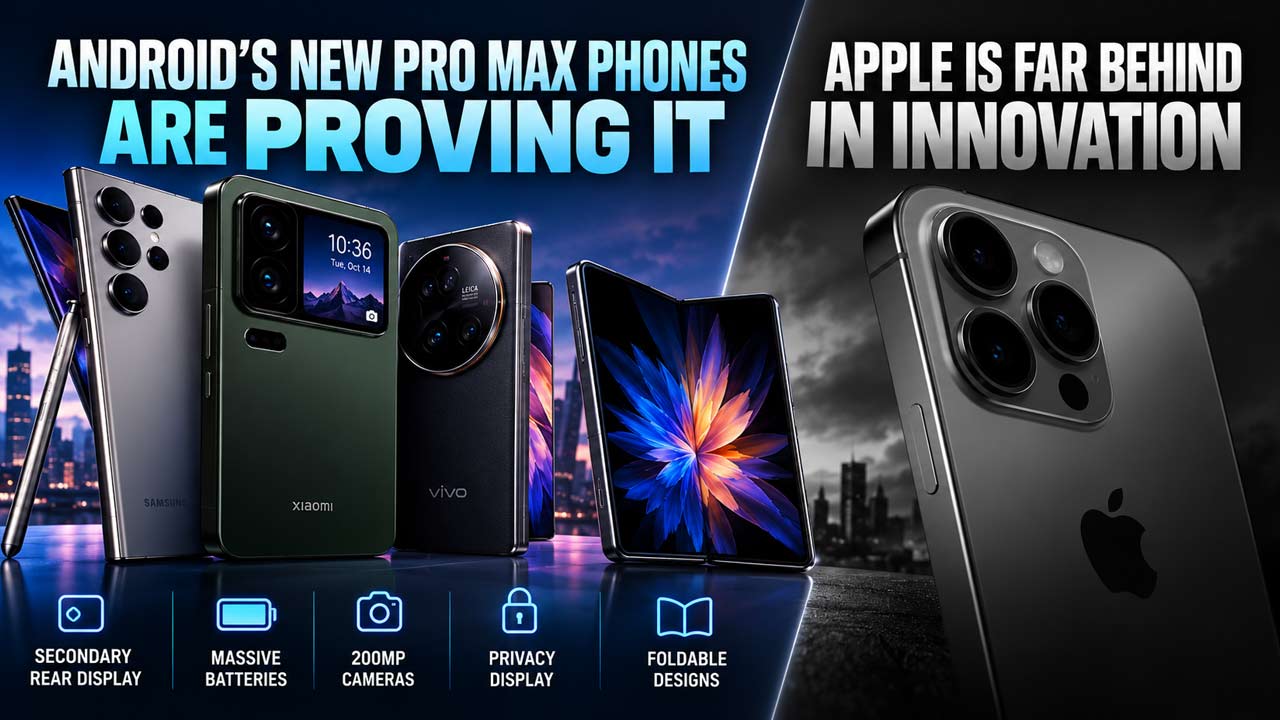
The 2026 flagship market includes phones such as the Samsung Galaxy S26 Ultra, while Xiaomi and other Chinese manufacturers are pushing extremely large batteries, sophisticated camera hardware, and unusual display technology.
Samsung’s Galaxy S26 Ultra, for example, introduces a built-in Privacy Display that can restrict viewing angles directly from the phone’s display.
It also combines a 200MP main camera with a 50MP telephoto camera, 5x optical zoom, and up to 100x Space Zoom.
These aren’t simply incremental specification increases. They are attempts to solve different problems with the smartphone itself.
The “Pro Max” Race Has Become a Hardware Arms Race
The most interesting development this year is the emergence of extremely ambitious “Pro Max” phones across Android manufacturers.
Multiple major manufacturers are launching flagship devices using the Pro Max branding, with the broader flagship race involving companies including Xiaomi, Huawei, vivo, OPPO and Honor.
Some of these devices are pushing camera configurations with as many as three 200MP sensors.
Xiaomi is an especially good example of how aggressive the Android flagship market has become.
Reports surrounding the Xiaomi 18 Pro Max point toward an enormous 8,500mAh battery alongside a 200MP main camera and 200MP periscope telephoto camera.
The phone is also expected to use a high-silicon-content battery design and Leica camera technology.
Compare that philosophy with Apple’s approach. Apple’s iPhone 18 Pro Max is focused on improving an already mature formula.
It introduces a variable-aperture 48MP Fusion Main camera, a newer A20 Pro chip, improved thermal management, and a larger battery.
Apple calls it the biggest battery-life improvement ever delivered on an iPhone Pro model. Those are significant upgrades. But the contrast in philosophy is hard to ignore.
Android is asking, “How far can we push the hardware?” Apple is asking, “How much better can we make the existing experience?”
Apple’s iPhone 18 Pro Max Is Innovative – Just in a Different Way
It would be unfair to claim that Apple has stopped innovating.
The iPhone 18 Pro and Pro Max finally bring variable aperture to Apple’s main camera.
The system allows you to control aperture alongside Apple’s new Pro camera controls, giving the iPhone a more traditional camera-like approach to photography.
Apple has also introduced a next-generation vapor chamber designed to improve sustained performance.
Combined with the A20 Pro chip, Apple says the new Pro models deliver the highest sustained performance in iPhone history.
There is also Apple’s continued work on Apple Intelligence and the new Siri AI experience in iOS 27.
So the problem isn’t that Apple isn’t innovating.
The question is how frequently Apple is introducing genuinely new categories of smartphone hardware compared with Android manufacturers.
Cameras Are Where the Difference Is Most Obvious
Camera technology might be the clearest example.
Apple has traditionally been extremely good at combining camera hardware, computational photography, video processing, and a consistent user experience.
The iPhone remains particularly strong for video and professional-oriented workflows.
But Android manufacturers are increasingly throwing hardware at problems that Apple approaches more conservatively.
Samsung’s Galaxy S26 Ultra has a 200MP main sensor, 50MP telephoto, 50MP ultrawide, and 12MP front camera, with 5x optical zoom and 100x Space Zoom.
Samsung has also increased the aperture of its main camera and improved low-light video processing.
Meanwhile, some Chinese flagship manufacturers are pushing even further with enormous sensors, multiple high-resolution cameras and increasingly sophisticated periscope systems.
That has created a situation where Apple’s camera improvements can feel evolutionary even when they are technically impressive.
Apple’s variable aperture is useful, but competitors are simultaneously pushing sensor size, optical reach, and multi-camera capabilities further.
Battery Technology Is Another Major Difference
Battery life may be the area where Android’s willingness to experiment is becoming impossible to ignore.
Apple has made a significant move with the iPhone 18 Pro Max. Reports indicate that it uses Apple’s largest phone battery yet, with capacities exceeding 5,300mAh depending on the model.
That’s a substantial change for an iPhone. But Android manufacturers are going much further.
An 8,500mAh battery in a premium Xiaomi Pro Max phone represents a completely different approach to flagship battery design.
It demonstrates that manufacturers are willing to prioritize endurance even if it requires significant changes to battery chemistry and internal architecture.
This is important because battery technology has historically been one of the areas where smartphone manufacturers have been relatively conservative.
Android’s flagship market is now making battery capacity a headline feature.
Samsung Is Experimenting With the Smartphone’s Display
Samsung’s Galaxy S26 Ultra provides another example of where Android is taking risks.
The phone includes what Samsung describes as the world’s first built-in Privacy Display on a mobile device.
You can activate it to prevent people nearby from viewing the contents of the screen, and Samsung says the functionality can also be configured to hide particular apps, notifications, or sensitive information.
It’s an interesting concept because it isn’t simply a brighter screen or a higher refresh rate. It changes how the display itself works in public environments.
That kind of feature represents the type of experimentation that has historically helped distinguish Android flagships from iPhones.
Secondary Displays Are Coming Back
One of the clearest examples of Android manufacturers thinking beyond the conventional smartphone design is the return of the secondary display on the back of the phone.
Instead of treating the rear panel purely as a surface for the camera module as the iPhones do, some of the newest Android flagships are turning it into an additional interactive screen.
The idea isn’t entirely new; phones such as the Xiaomi Mi 11 Ultra experimented with a small rear display several years ago, but the latest implementations show that manufacturers haven’t abandoned the concept.
A rear display can serve several practical purposes. It can work as a viewfinder for taking selfies with the primary rear cameras, allowing you to use the significantly better main camera hardware instead of the front-facing camera.
It can also display notifications, the time, battery information, animations, widgets, and other information without requiring the main display to be turned on.
More importantly, it gives manufacturers another way to differentiate their flagship phones.
This is exactly the type of feature that makes the current Android flagship market interesting.
Instead of simply increasing the resolution or processor performance, manufacturers are experimenting with additional hardware surfaces and new ways of interacting with the phone.
Apple has not introduced anything comparable on the iPhone. The iPhone’s rear panel remains largely dedicated to its camera system and MagSafe ecosystem, while the front display remains the primary interactive surface.
The rear display may not become a mainstream feature across every flagship, but its return is significant.
It shows that Android manufacturers are still willing to experiment with form and functionality.
Apple’s Biggest Strength Is Also Its Biggest Limitation
Apple’s conservative approach isn’t necessarily a weakness for everyone.
The company has enormous advantages in silicon design, software integration, ecosystem integration, camera processing, and long-term platform support.
Apple’s ability to control the processor, operating system, and hardware gives it an unusual level of control over the entire product.
That’s why the iPhone 18 Pro Max doesn’t need an 8,500mAh battery or three 200MP cameras to compete.
Apple is optimizing the entire experience rather than simply maximizing individual specifications. But there is a downside.
When Apple waits until a technology is mature before adopting it, Android manufacturers get years to experiment with different implementations.
Foldables are probably the most obvious example.
Samsung, Google, Motorola, and Chinese manufacturers have spent years iterating on foldable designs while Apple has yet to make a conventional foldable iPhone part of its mainstream lineup.
Apple’s foldable phone is out, but the company’s approach remains considerably later than Android’s.
That means Android manufacturers get to define what the category looks like before Apple enters it.
The Smartphone Industry Is Moving Beyond the iPhone Formula
The bigger story isn’t really Apple versus Android.
It’s that the smartphone industry is becoming less centered around Apple’s definition of what a flagship phone should be.
Android manufacturers are experimenting with enormous batteries, increasingly powerful zoom cameras, privacy-focused displays, foldable designs, AI-driven interfaces, high-resolution sensors, and radically different hardware configurations.
Apple, meanwhile, is refining the traditional premium smartphone formula.
The iPhone 18 Pro Max shows that Apple can still introduce meaningful technology. Variable aperture, improved sustained performance, and significantly better battery life are not trivial upgrades.
But when a Xiaomi flagship can potentially arrive with an 8,500mAh battery and multiple 200MP cameras, while Samsung is putting a built-in privacy display into its flagship, Apple’s approach can feel less adventurous by comparison.
Apple Isn’t Behind on Everything, But the Innovation Gap Is Changing
The argument that Apple is simply “behind” Android is too simplistic.
Apple remains extremely competitive in performance, software integration, video recording, ecosystem features, and silicon efficiency.
The iPhone 18 Pro Max is evidence that the company is still capable of substantial engineering improvements.
But if innovation means introducing unusual hardware, taking bigger risks, and experimenting with what a smartphone can physically do, Android manufacturers currently have a much broader playground.
And that’s probably the most interesting development of 2026.
For the first time in years, Apple doesn’t automatically feel like the company everyone else is waiting to follow.
In several areas, Apple is the company watching what Android manufacturers do next.
And if the next generation of Pro Max and Ultra phones continues pushing battery technology, cameras, displays, and form factors this aggressively, Apple may eventually need to do more than refine the iPhone formula.