Smartphones reached “good enough” years ago, but hardware manufacturers still need a reason to charge four figures every autumn.
When genuine leaps in battery life or display tech plateaued, the industry pivoted from solving real consumer frustrations to engineering solutions for problems nobody had.
Marketing departments justify premium pricing with spec-sheet padding features that look impressive on a presentation slide or in an unboxing video, yet end up completely ignored after forty-eight hours of ownership.
These are the most useless smartphone features and upgrades you do not actually need.
1. The 2MP Filler Cameras (Macro and Depth Sensors)
Pick up almost any budget or mid-range handset, flip it over, and you will likely see a triple- or quad-camera module.
Two of those lenses exist solely so the manufacturer can write “Quad Camera Array” on the retail box.
The offenders are almost always a 2-megapixel macro lens and a 2-megapixel depth sensor.
A 2MP macro sensor produces grainy, color-washed close-ups that look worse than a cropped photo taken with the primary lens.
Meanwhile, modern computational photography handles depth mapping in software far better than a throwaway auxiliary sensor ever could.
They are cosmetic hardware padding, taking up internal space that could have been used for a slightly larger battery.
A single great camera sensor paired with decent optics is infinitely more valuable than four mediocre ones stuffed onto a bump.
2. 8K Video Recording
Unless you are a commercial filmmaker with a dedicated workstation, an external high-speed SSD, and an 8K television, 8K video capture on a phone is impractical.
A single minute of 8K footage burns through roughly 600MB or more of internal storage, causes thermal throttling within minutes, and often disables lens switching or optical stabilization.
Most users watch their videos on the very same 6-inch phone display, an iPad, or a standard 4K TV. You simply cannot resolve that pixel density with human vision from casual viewing distances.
Sharp, well-stabilized 4K at 60fps is still far more practical for everyday shooting.
3. Gimmicky Generative AI
Generative AI has its utility, but smartphones have become saturated with half-baked AI features that serve little real-world purpose.
Rewriting a casual text message into three different synthetic corporate tones, turning vacation photos into grotesque anime avatars, or generating AI wallpaper on the fly are novelties that wear off by day two.
Worse, several brands have treated these features as headliners to distract from the fact that the underlying hardware, sensors, chassis, and battery chemistry remained largely unchanged.
Unless an AI feature makes speech recognition faster, auto-categorizes receipts accurately, or manages battery efficiency behind the scenes, it belongs in a downloadable app, not the core marketing pitch for a $1,200 hardware refresh.
4. Gimmick AI Camera Magic
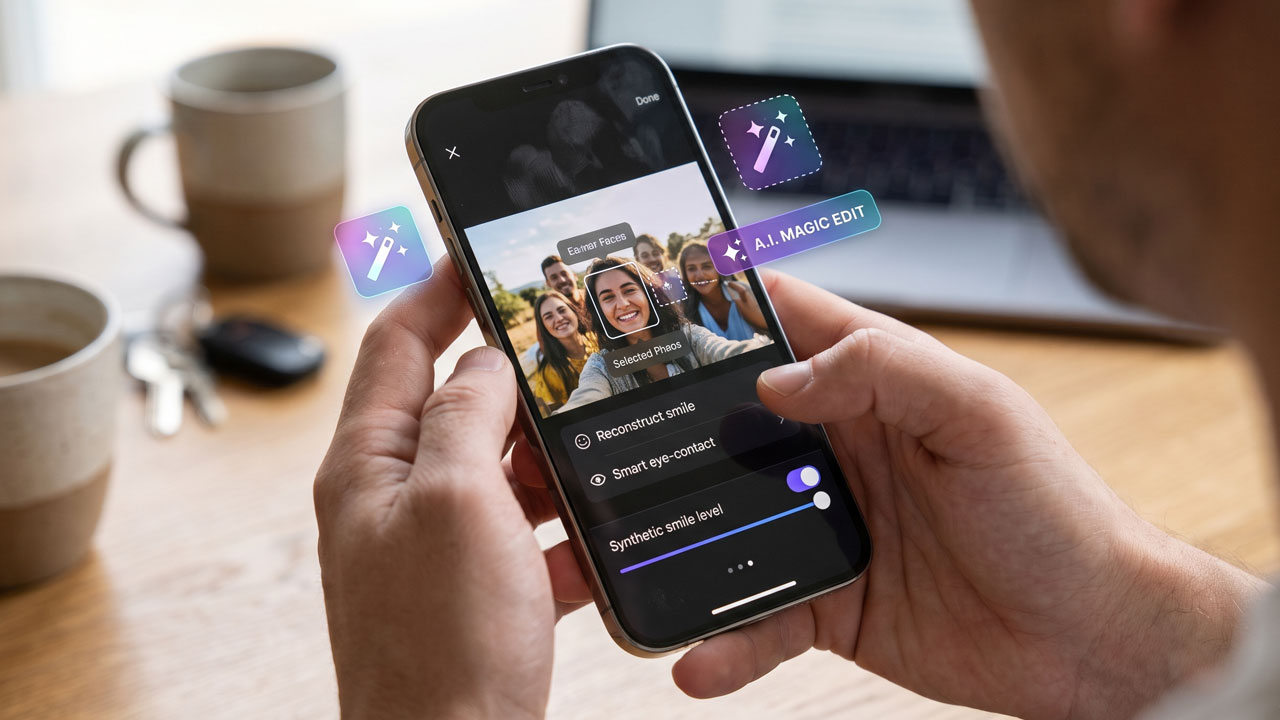
Generative AI has become the centerpiece of phone launches. While computational photography (smart HDR, low-light night modes, and portrait segmentation) genuinely improved mobile photography over the last decade, recent additions are crossing into digital fabrication.
Do you actually need a tool that swaps a frowning face with an artificial smile, or replaces an overcast sky with a synthetic magenta sunset?
Features like generative object expansion, hallucinated backgrounds, and automated cartoon avatar creators are fun for an afternoon, but they aren’t photography; they’re synthetic imagery.
Paying a $200 hardware premium for on-device neural processing units (NPUs) just to generate synthetic stickers isn’t an upgrade; it’s bloat.
5. Space Zoom (100x and Beyond)
Periscope optical zoom lenses capable of 3x or 5x magnification are legitimately helpful for portraits and framing cityscapes. What isn’t helpful is the absurd marketing arms race pushing digital zoom out to 100x.
At 100x, holding a phone steady without a hefty tripod is nearly impossible, and the final output is either a muddy, watercolor smudge or an algorithmic estimate of what the camera thinks you were pointing at.
Unless your daily hobby involves attempting to read distant billboard fine print across a highway, it’s a parlor trick you will use once and never open again.
6. Reverse Wireless Charging
Setting a phone face-down on a desk to wirelessly top up a pair of earbuds sounds clever in a launch keynote. In practice, it is slow, wildly inefficient, and generates excess heat.
Wireless charging already loses 20% to 30% of its energy to heat dissipation.
Doing it from a phone’s internal cell drains the primary battery far faster than it actually refills the accessory.
Trying to keep the charging coils aligned in a pocket or backpack is nearly impossible, meaning you must leave both devices immobilized on a flat surface.
When in a pinch, carrying a standard short cable is faster, cooler, and significantly more reliable.
7. 144Hz to 165Hz Mobile Refresh Rates
The jump from 60Hz to 90Hz or 120Hz was one of the single best quality-of-life improvements in modern phone history, providing silky animations and immediate touch response.
However, pushing mobile panels beyond 120Hz up to 144Hz or 165Hz yields rapidly diminishing returns.
On a compact display, human eyes struggle to register the marginal fluidity above 120Hz, but the battery pack certainly registers the extra drain.
Outside of niche competitive mobile esports titles, extra hertz is just spec-sheet padding.
8. Virtual RAM Expansion
Often advertised as “12GB + 8GB Extended RAM,” this feature is software trickery repackaging an ancient computing concept: paging files (swap space).
Your phone’s flash storage (UFS or eMMC) is orders of magnitude slower than dedicated LPDDR RAM.
Shuffling active background tasks into flash storage does not make a phone perform like a device with true hardware memory; in some cases, it can cause micro-stutters and unnecessary read/write wear on the storage drive.
If a phone has 8GB of actual RAM, modern memory management already handles everyday multitasking seamlessly without dipping into storage paging.
9. Ceramic, Titanium, and Fragile Luxury Materials
Every couple of generations, brands debut an aerospace-grade alloy or a bespoke frosted coating to claim lighter frames and structural stiffness.
The irony? Within fifteen minutes of unboxing a $1,200 phone, 95% of buyers slap a $15 TPU rubber case directly over that hand-finished titanium or ceramic back.
Unless you are daring enough to run your glass-sandwich device completely naked, paying extra for exotic chassis materials provides virtually zero functional difference in your day-to-day use.
What Actually Matters When Buying a Phone?
If you are deciding whether your current phone is truly due for replacement, strip away the keynote fluff. The upgrades that actually improve your daily routine are boring, unsexy, and straightforward:
- Sustained Battery Health: Can it comfortably survive a heavy day off the charger without battery-saver anxiety?
- Software Support Longevity: Does the manufacturer guarantee 5 to 7 years of active security patches and operating system updates?
- Display Legibility: Can you read your screen in direct midday sunlight without squinting?
- Real-World Durability: Reliable IP68 water resistance and drop-tolerant front glass.
If a phone is two or three years old, its processor, screen, and primary camera are already capable of handling almost everything thrown at them.
Unless an upgrade offers meaningful physical durability, genuine all-day endurance under heavy workloads, or long-term software support, tuning out the spec race is usually the smarter move.
Next time a brand tells you that their new phone will redefine your lifestyle with 8K recording and 120x neural zoom, hold onto your wallet. You probably don’t need a new phone; you just need a fresh battery.