Apple spent years developing its first foldable smartphone.
The company entered the market after Samsung and other Android manufacturers had already spent multiple generations refining their foldable designs.
Yet, just days after the iPhone Duo’s launch on October 23, 2026, reports of cracked inner displays and hinge problems have raised serious questions about Apple’s execution
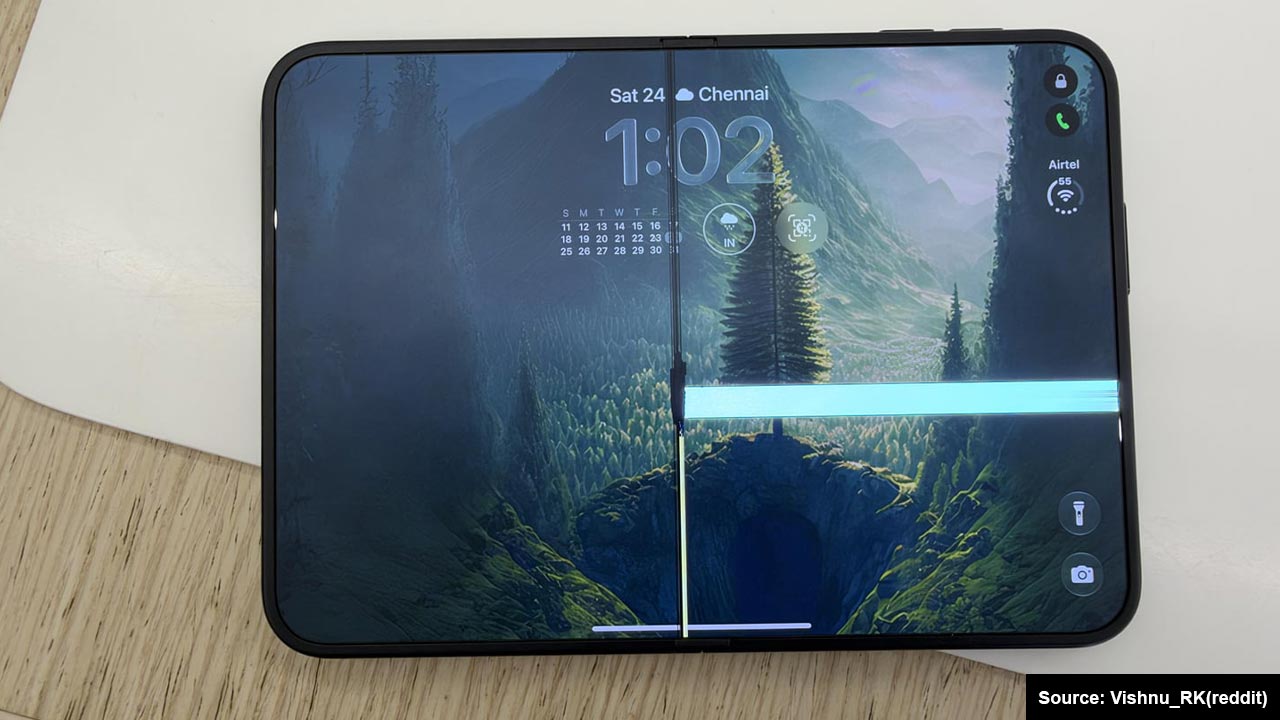
The biggest concern is the inner display. Multiple early buyers reported screen failures after only hours or days of use, with some devices developing cracks and bright lines along the central folding area.
Apple acknowledged the issue on October 26, confirming that a small number of iPhone Duo units were affected and advising customers to contact AppleCare for replacements.
The company has not confirmed the underlying cause.
The display failures are only part of the problem. The iPhone Duo also faces criticism over hinge durability, dust exposure, application compatibility, camera limitations, weight, and multitasking.
Together, they expose the challenges Apple still faces in the foldable smartphone market.
1. Inner Display Cracks After Just Hours of Use
The most serious issue surrounding the iPhone Duo is its folding display.
Several owners reported cracks, bright lines, and other display malfunctions shortly after purchasing the device.
One Australian owner reported a failure after approximately six hours of use and fewer than 20 openings.
Other owners described hearing a crunching sound or feeling unusual resistance while unfolding their phones, followed by visible display damage.
Some reported no drops, impacts, or obvious external damage before the failure.
These reports are concerning because the inner display is the defining feature of the iPhone Duo.
A folding phone loses much of its appeal when you cannot trust its screen to survive ordinary use.
Apple acknowledged that a small number of devices are affected and directed customers experiencing display problems to AppleCare for replacements.
The company has not disclosed the number of affected units or confirmed whether the failures stem from a manufacturing defect or a broader design issue.
The available evidence does not establish a widespread failure across every iPhone Duo. However, multiple similar reports appearing within days of launch demand a proper explanation from Apple.
2. The Hinge Design Raises Serious Questions
The display failures have brought the iPhone Duo’s hinge under scrutiny.
A foldable hinge must support the screen, manage the bending motion, and protect delicate display components throughout repeated opening and closing cycles.
Repair specialist iFixit investigated the reported failures using teardown footage, patents, CT scans, and a three-dimensional hinge model.
Its analysis found that the reported damage clustered near the transition between the display cable opening and the central hinge support.
iFixit identified a possible stress concentration in this area, where several structural edges meet beneath the flexible display.
Its simulation showed how insufficient clearance around the central support could place additional pressure on the folding screen.
Apple has not confirmed the cause, but the repeated pattern puts the hinge assembly and the support structure beneath the display at the centre of the investigation.
3. Dust Can Reach the Hinge Despite the Phone’s Resistance Rating
Dust protection remains another challenge for the iPhone Duo.
Apple advertises IP68 protection, but that rating does not mean every moving component inside a foldable is completely protected against fine particles.
During its teardown investigation, iFixit exposed the Duo to fluorescent powder and tracked where the particles travelled.
Some powder reached the moving hinge components, and the hinge began producing a crunching sound.
This was an investigative test, not a formal certification test or proof that normal household dust will damage every device.
Nevertheless, it demonstrates that particles can reach parts of the mechanism despite the phone’s advertised resistance rating.
This matters because cleaning or repairing the hinge requires substantial disassembly.
The flexible display and its supporting components obstruct easy access to the mechanism.
A premium foldable needs to withstand the conditions of everyday use. You should not have to treat a phone’s hinge as an unusually delicate component during routine activities.
4. The Inner Display’s Crease Remains a Long-Term Concern
Apple has focused heavily on making the iPhone Duo’s central crease less noticeable.
Its display finish reduces reflections and makes the folding line less distracting when the device is unfolded.
However, a less visible crease does not eliminate the mechanical stress associated with folding a flexible display.
Repeated folding tests have drawn attention to changes in the crease’s appearance over time.
This is not a problem exclusive to Apple. Samsung and other foldable manufacturers have also faced challenges involving crease visibility and long-term screen durability.
The criticism is that Apple entered the market with years of competitor experience available to study.
Customers paying a premium for its first foldable reasonably expect the company to address established weaknesses in the category rather than simply deliver a more attractive crease at launch.
5. Third-Party Applications Are Not Fully Optimised
A foldable smartphone needs software that adapts to two different screen sizes.
Applications that work well on a conventional phone must also make effective use of the larger inner display.
Early iPhone Duo users have reported applications with awkward layouts, wasted screen space and compatibility problems.
Some applications display black bars or fail to use the larger screen effectively.
Apple’s own applications generally offer a more controlled experience, but third-party developers need to adapt their software to the new form factor. That transition takes time.
Even so, the limitations undermine one of the Duo’s main selling points. The larger display is supposed to provide more room for browsing, reading, productivity, and entertainment.
Applications that fail to adapt make unfolding the phone less useful.
Apple has years of experience developing iPadOS and optimising applications for different screen sizes.
Its first foldable still needs a more mature application experience to justify its place in the premium smartphone market.
6. Touch ID Replaces Face ID
The iPhone Duo abandons Face ID in favour of Touch ID integrated into the side button.
This is a notable compromise for customers accustomed to unlocking their iPhones with facial recognition.
Touch ID remains a reliable authentication method, and its side-mounted implementation works with the phone folded or unfolded.
However, the location of the sensor affects convenience depending on how the device is held.
The removal of the familiar flagship feature from its most expensive smartphone category means Customers upgrading from recent Pro models must adjust to a different unlocking process.
The choice reflects the physical constraints of a folding design, but it still represents a reduction in convenience for some users.
A premium device should deliver a consistent everyday experience, especially for basic tasks such as unlocking the phone and authenticating purchases.
7. The Camera System Lacks a Dedicated Telephoto Lens
The iPhone Duo’s folding design comes with camera compromises. Its rear camera system lacks the dedicated telephoto lens found on Apple’s conventional Pro flagships.
That limits the Duo’s versatility for distant subjects, optical zoom photography, and certain portrait compositions.
The Duo still offers useful photography features, including its large inner display and the ability to use the outer screen for previews.
However, these features do not replace the flexibility of a dedicated telephoto camera.
Apple has built its reputation partly on delivering strong cameras across its premium iPhone range. The Duo forces you to choose between a folding display and a more complete camera system.
That compromise is understandable from a space-management perspective, but it remains difficult to justify at the top end of the smartphone market.
8. The iPhone Duo Is Heavier Than Some Rivals
The iPhone Duo weighs approximately 254 grams, making it a substantial device for extended one-handed use.
Its weight is more noticeable when the phone is unfolded, and you hold the large display for reading, video calls, or multitasking.
Samsung’s Galaxy Z Fold8, by comparison, weighs approximately 201 grams. The difference is around 53 grams.
Weight alone does not determine whether a foldable is well designed. Structural strength, battery capacity, display size, and materials all influence the final result.
However, foldable manufacturers have spent several generations reducing bulk while maintaining durability. Apple’s first attempt still feels heavy compared with some competing designs.
The Duo offers a large display in a relatively compact folded footprint, but its weight makes prolonged use less comfortable than the dimensions alone suggest.
9. Thermal Performance Needs Attention
Early user reports and reviews have also raised concerns about the iPhone Duo becoming noticeably warm during certain activities.
Heat is a normal consequence of demanding workloads, including video calls, photography, and intensive applications.
A foldable’s internal layout also creates different thermal-management challenges from those of a conventional smartphone.
The reported warmth does not establish a widespread overheating defect. However, thermal behaviour deserves scrutiny because excessive heat affects comfort, sustained performance and battery efficiency.
Apple has incorporated cooling hardware into the Duo, but the launch-period reports showed the importance of testing that system under sustained workloads and in different environmental conditions.
Apple needs to ensure that the device maintains consistent performance without becoming uncomfortable during everyday use.
10. Multitasking Is More Restricted Than Expected
The large inner display should make the iPhone Duo useful for productivity, but its multitasking implementation has limitations.
There are restrictions on application layouts, including a fixed split-screen arrangement and limited flexibility when managing multiple applications simultaneously.
The experience does not offer the same freedom that you expect from a tablet-oriented interface.
A foldable does not need to replicate every feature of an iPad. However, a larger screen should provide meaningful advantages beyond displaying a bigger version of a conventional phone interface.
Apple already has extensive experience with multitasking on its tablets. The Duo’s restrictions show that the company still needs to adapt that experience to a device that switches between a compact phone and a larger workspace.
More flexible window management would make the Duo more useful for productivity and would better justify its premium price.
11. The Display Finish Involves Visual Trade-Offs
The Duo’s display finish reduces reflections and makes the central crease less noticeable, but there are visual compromises.
Compared with conventional flagship displays, the inner screen can look less crisp in some circumstances, with differences in perceived contrast and colour presentation.
This is even worse for people who use their phones extensively for video and photography.
Apple has prioritised a less distracting crease, but buyers also expect excellent image quality from a premium smartphone.
The display must deliver both a practical folding experience and a high-quality picture.
12. Inner Display Repairs Are Expensive
Repairing a folding display is more complicated than replacing the screen on a conventional smartphone.
The flexible panel, supporting layers, adhesives, and hinge assembly make the process labour-intensive.
iFixit awarded the iPhone Duo a provisional repairability score of 5 out of 10, the highest score it had given a foldable smartphone at the time of its teardown.
It praised aspects such as battery removal and access to smaller components, while identifying the inner display and hinge as major repair challenges.
The financial implications are significant. iFixit reported an out-of-warranty inner-display replacement cost of $999 in the United States.
That is an expensive repair for a device that already carries a premium purchase price.
Warranty coverage and AppleCare terms affect the amount an owner actually pays, but the underlying repair complexity remains.
Apple’s replacement guidance for affected units is an appropriate response to the early failures.
The company must also ensure that replacement parts remain available and that owners receive clear information about warranty coverage and repair options.
Conclusion: Apple’s First Foldable Has Too Many Compromises
The iPhone Duo demonstrates Apple’s ability to build a sophisticated foldable smartphone, but its early problems expose the limits of the company’s experience in this category.
The reported inner-display failures are the most serious concern.
Similar damage appearing around the folding area, sometimes after only a few hours of use, raises questions about the hinge and display-support structure.
The other shortcomings paint a broader picture. Application compatibility needs improvement, multitasking remains restrictive, the camera system lacks a dedicated telephoto lens, the device is heavy, and the display finish involves visual trade-offs.
Some are inherent challenges of foldable hardware, while software shortcomings can improve through updates.
Apple entered the foldable market after competitors had already spent years refining their designs.
The company had the benefit of studying those products and their weaknesses. Its first foldable still faces many of the same practical challenges.
The iPhone Duo is an ambitious first attempt, but ambition does not excuse poor execution.
Apple needs to improve durability, reduce everyday compromises, and deliver a more complete foldable experience.
Until then, the Duo’s premium price and early reliability concerns make it difficult to recommend over a mature conventional flagship or an established competing foldable.
Apple’s next generation needs to demonstrate measurable improvements, particularly in display reliability and hinge durability.
That is how the company will establish credibility in a category where it is still catching up.