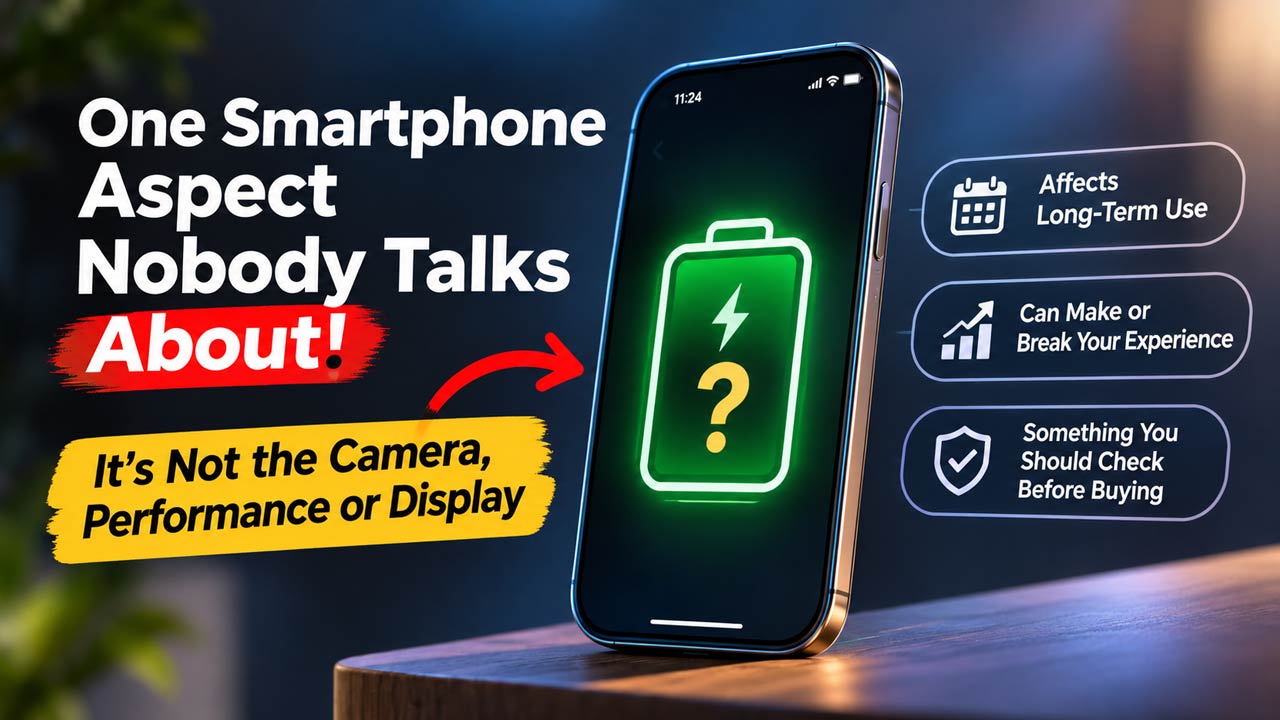
When buying a new smartphone, most people focus on the same things: processor performance, camera quality, display resolution, battery capacity, and charging speed.
Manufacturers know this, which is why their advertisements are filled with impressive benchmark scores, high-megapixel cameras, bright displays, and promises of charging a phone from zero to 100% in minutes.
But there is one important aspect that rarely receives the attention it deserves: battery lifespan.
A smartphone might have the best camera in its price segment, a flagship processor and a gorgeous display, but what happens when its battery starts deteriorating after a year or two?
The phone that once lasted an entire day may suddenly need to be charged by the afternoon.
You might find yourself carrying a power bank everywhere or looking for a charging socket whenever you leave home.
Despite being one of the most important components of a smartphone, battery lifespan is often overlooked when comparing devices.
And considering how expensive smartphones have become, it is something you should pay much more attention to.
Battery Life and Battery Lifespan Are Not the Same Thing
One reason this aspect gets overlooked is that people often confuse battery life with battery lifespan. Although the two are related, they describe different things.
Battery life refers to how long your smartphone lasts on a single charge. It depends on factors such as battery capacity, processor efficiency, display technology, software optimisation, and your usage habits.
A phone with a 6,000mAh battery might last longer than a device with a 5,000mAh battery, although the actual result depends on several other factors.
Battery lifespan, on the other hand, refers to how long the battery remains useful before its capacity and performance deteriorate significantly.
A smartphone might deliver excellent battery life when it is new, but that does not necessarily mean its battery will retain that performance for three or four years.
Most modern smartphones use lithium-ion or lithium-polymer batteries. These batteries gradually lose their ability to store energy as they go through charging cycles and age over time.
Eventually, a battery that once comfortably lasted a full day might struggle to provide the same endurance.
This distinction is important because a phone with excellent battery life on day one may not necessarily be the better long-term purchase.
Why Smartphone Batteries Deteriorate Over Time
Battery degradation is a normal part of owning a smartphone.
Every rechargeable battery experiences some degree of chemical ageing, but the rate at which it happens can vary considerably.
One of the main factors is the number of charge cycles.
A charge cycle generally represents the cumulative use of an amount of battery equivalent to 100% of its capacity.
For example, using 50% of your battery today and another 50% tomorrow adds up to approximately one full cycle.
It does not mean you must charge your phone from zero to 100% in a single session.
As charge cycles accumulate, the battery’s maximum capacity gradually decreases.
A battery that originally held 5,000mAh worth of charge may eventually retain noticeably less energy, reducing the time the phone can run between charges.
Heat is another major factor. Regularly exposing a smartphone to high temperatures can accelerate battery ageing.
Heavy gaming while charging, leaving a phone in direct sunlight, or using demanding applications in a hot environment can increase thermal stress.
Charging habits also play a role. Keeping a lithium-ion battery at a very high or very low charge level for extended periods can contribute to degradation.
Frequent fast charging can generate additional heat, although the actual effect depends on the phone’s charging system, temperature management, and charging conditions.
This does not mean that fast charging is inherently bad or that you should obsess over every percentage point.
Modern smartphones incorporate charging controls and thermal protections. However, the way a device manages heat and charging over several years can influence how well its battery holds up.
The Problem With Smartphone Marketing
Smartphone manufacturers spend considerable time advertising battery capacity and charging speeds.
We regularly see phones marketed with 5,000mAh or 6,000mAh batteries, along with charging systems capable of delivering impressive power.
These specifications are useful, but they do not tell the whole story.
A larger battery can provide better endurance when a phone is new, but it does not automatically guarantee a longer battery lifespan.
Likewise, a phone that supports 100W charging is not necessarily going to experience poor battery health, because charging speed alone does not determine how quickly a battery degrades.
What you really need to know is how well a battery will perform after hundreds of charging cycles and several years of regular use.
Does the manufacturer specify how much capacity the battery should retain after a certain number of cycles?
Does the phone have effective thermal management? Does its software offer optimised charging or a charge limit? Is replacing the battery affordable and convenient?
These questions can tell us far more about the long-term ownership experience than a charging-speed number on a product page.
Unfortunately, battery longevity figures are not presented as consistently or prominently as processor benchmarks, camera specifications, and display refresh rates.
This makes it difficult to compare phones based on how well their batteries are expected to age.
Why Battery Lifespan Matters More Than Ever
Smartphones are becoming very expensive, and many of us now expect our devices to last three, four, or even five years.
Software support has also become an important selling point, with several manufacturers promising extended operating system and security updates.
However, long software support is only part of the equation.
A smartphone may continue receiving updates for years, but if its battery has deteriorated significantly, the everyday experience can become frustrating.
You might need to charge the device more frequently, reduce screen brightness, avoid certain applications, or carry a power bank.
In some cases, you have to replace an otherwise perfectly functional smartphone simply because its battery no longer meets your needs.
The processor may still be fast enough, the camera may still take excellent photographs, and the display may remain in great condition. Yet declining battery performance can make the entire device feel old.
This creates an unnecessary dilemma. You can continue using an inconvenient phone, pay for a battery replacement, or spend money on a new smartphone.
A replaceable battery or an affordable, accessible replacement service can make a significant difference here.
If a phone is designed to be maintained easily, you may be able to extend its useful life without replacing the entire device.
From both a financial and environmental perspective, that is a benefit worth considering.
Battery Health Should Be a Key Smartphone Specification
Imagine comparing two smartphones with similar processors, displays, cameras, and initial battery endurance.
One manufacturer provides clear information about battery longevity, while the other only advertises capacity and charging speed.
The first device gives you more information to make an informed decision, especially if you intend to keep the phone for several years.
Battery health should be treated as a meaningful part of smartphone specifications, rather than an obscure detail hidden in technical documentation.
Manufacturers could make comparisons easier by publishing standardised battery endurance figures, expected capacity retention after a defined number of charge cycles, and information about battery replacement costs.
For example, manufacturers could clearly state whether a battery is designed to retain at least 80% of its original capacity after a specified number of complete charge cycles under defined test conditions.
Some brands already publish figures of this kind for certain devices, but the information is not presented uniformly across the market.
Such claims should be based on transparent testing conditions, because actual battery ageing varies with temperature, usage, charging habits, and time.
A standardised approach would help consumers distinguish between a phone that merely has a large battery and one that is designed to maintain useful battery performance over the long term.
How to Make Your Smartphone Battery Last Longer
Although battery degradation cannot be eliminated, a few sensible habits can help slow it down.
Avoid excessive heat whenever possible. Do not leave your phone in direct sunlight for extended periods, and avoid demanding gaming sessions while the device is already running hot.
If a phone becomes unusually hot during charging, investigate the cause instead of ignoring it.
Use optimised charging or battery protection features if your smartphone offers them.
Depending on the device, these features may limit charging to a selected percentage or delay charging to 100% until closer to the time you normally unplug the phone.
You also do not need to drain your battery completely before charging it.
Lithium-ion batteries do not require the old-fashioned full discharge routine associated with some earlier battery technologies. Charging in smaller increments is perfectly fine.
Fast charging can still be useful when you need power quickly. There is no need to avoid it entirely, but using a slower charging option when speed is unnecessary may help reduce heat in some circumstances.
The benefit depends on the device and its charging implementation.
Most importantly, do not turn battery maintenance into a daily obsession.
Modern smartphones are designed to manage charging automatically, and normal usage will inevitably cause some degradation.
The goal is to avoid unnecessary stress, not to preserve 100% battery health forever.
Final Thoughts
Battery lifespan might not be the most exciting smartphone feature, but it can have a major impact on the ownership experience.
A high-resolution camera, a powerful processor, and a fast display are easy to appreciate when a phone is new. Battery health becomes much more important as the months and years pass.
The industry has made considerable progress in charging speeds, battery capacities and power efficiency.
Now, it is time for manufacturers to give battery longevity the same level of attention in their marketing and product specifications.
Consumers should not have to guess how well a smartphone’s battery will age or discover its limitations only after spending years using the device.
A smartphone should not be judged only by how good it is on the day you buy it, but also by how well it performs years later.
Battery lifespan deserves to be part of that conversation, and it is time we started treating it as a priority.