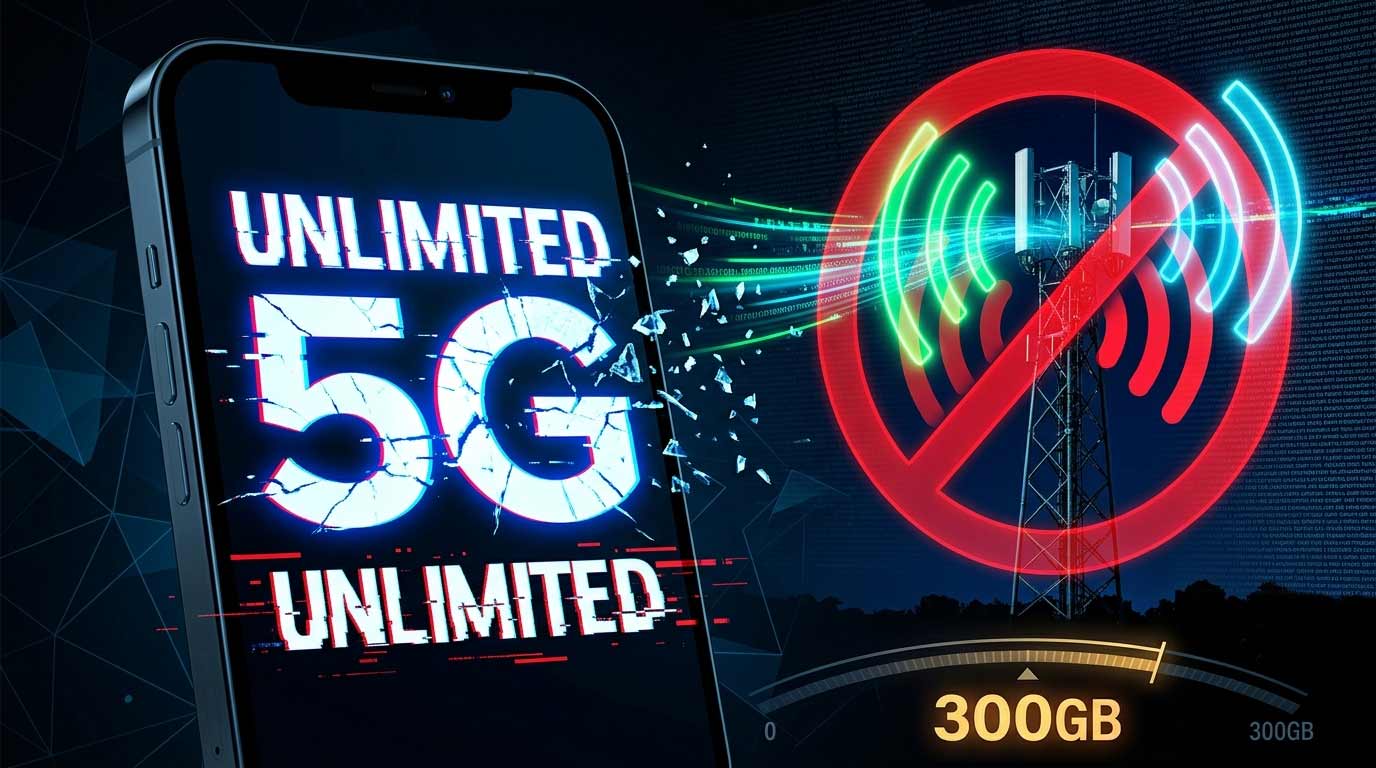
“Unlimited 5G data.” It sounds simple enough. Pay for the plan, connect your phone to 5G, and use as much data as you want.
Except that is not really how it works. In India, telecom operators love putting “Unlimited 5G” front and centre in their advertisements while burying the important restrictions inside their terms and conditions.
And once you actually read those terms, the word unlimited starts looking a lot less convincing.
This isn’t necessarily an outright scam in the legal sense. But calling these plans “unlimited” without immediately explaining the restrictions is absolutely misleading marketing.
The Big Problem With “Unlimited”
Take Airtel. Airtel’s current terms explicitly state that its unlimited-data price points are intended for personal, non-commercial use.
More importantly, Airtel defines commercial usage as more than 300GB of data in 30 days and reserves the right to suspend, modify, or throttle the service in cases it considers commercial or fraudulent.
So let’s get this straight: You are told you have unlimited data. You use a lot of data. You cross 300GB. Suddenly, your usage can be classified as commercial usage, and the operator can take action.
That’s not what most people understand when they hear “unlimited.” And Airtel isn’t alone.
Vi Also Has a 300GB Catch
Vi’s terms for its Unlimited 5G Data offer are even more explicit.
The company says the offer is for personal and non-commercial use, and defines commercial usage as more than 300GB of 5G data within 28 days.
If Vi detects commercial or fraudulent usage, it reserves the right to suspend or modify the offer, with speeds potentially being throttled down to 64kbps.
64kbps. That’s basically the kind of speed that makes you question whether the internet has gone back to 2005.
And yet the headline remains Unlimited 5G.
Jio Is Playing a Different Game
Jio’s situation is slightly different, which makes the whole “unlimited” argument even more interesting.
Jio currently offers unlimited 5G benefits on eligible plans, including plans priced at ₹349 or above in some of its current offers.
But that doesn’t mean every Jio unlimited-data offer is some magical bottomless pit of bandwidth.
Jio’s various plans and promotional offers come with their own eligibility conditions, validity periods and restrictions.
In other Jio unlimited-data services, the company explicitly reserves the right to withdraw unlimited-data benefits for misuse or commercial usage after specified thresholds.
For example, JioFiber’s terms identify usage above 3,300GB in a billing cycle as misuse.
The important point is that “unlimited” does not mean “the operator has promised to let you consume infinite data under every circumstance.”
It means you need to read the specific plan’s terms. And that’s exactly where the problem begins.
So Is Unlimited 5G a Scam?
Not necessarily. The operators aren’t secretly charging you for every gigabyte after you cross some hidden number.
The restrictions are generally written down in their terms and conditions. But here’s the uncomfortable part: The marketing says “UNLIMITED.” The fine print says “UNLIMITED, BUT…” That’s the issue.
Imagine buying an “unlimited buffet” where the restaurant doesn’t tell you that after eating five plates, it can decide you’re eating commercially and throw you out.
Sure, the terms might technically protect the restaurant. But calling the buffet unlimited would still give customers the wrong impression.
That’s essentially what happens with these telecom plans.
300GB Sounds Like a Lot – Until You Actually Use 5G
For a normal smartphone user, 300GB is a huge amount of mobile data.
If you’re primarily using WhatsApp, Instagram, YouTube, Spotify, Google Maps and occasionally downloading files, you’re probably never going to get close.
But 5G changes how people use mobile data.
A 5G phone can comfortably become a gaming download machine, a 4K streaming device, a cloud backup connection, a work-from-home internet and TV streaming connection
And suddenly 300GB isn’t completely ridiculous. Download a few large games, watch a lot of 4K video, back up photos and videos, download Windows or game updates.
Do that throughout the month, and your data consumption can climb surprisingly quickly.
That’s where the definition of “unlimited” becomes important.
The Real Catch: It’s Not About Running Out of Data
The biggest misconception is that the operator will simply say:
“You’ve used 300GB. Your data is finished.”
That’s not necessarily what happens.
Instead, the operator can classify excessive usage as commercial, fraudulent, or abusive usage depending on its terms.
And then it can throttle your speed, suspend the offer, modify the service, withdraw unlimited benefits, and take other action permitted under the terms
That is the part consumers need to understand before assuming “unlimited” means 24/7 full-speed 5G with zero restrictions.
And Then There’s the 5G Coverage Problem
There’s another massive asterisk that doesn’t get nearly enough attention. Unlimited 5G only matters when you’re actually connected to 5G.
If your phone drops back to 4G, your normal plan’s data allowance can apply.
Vi’s terms, for example, specify that its unlimited 5G benefit can only be accessed in designated 5G areas and depends on network availability.
So the advertisement might effectively say Unlimited 5G data.
The real-world version is closer to Unlimited 5G data when you’re eligible, on the right plan, using a compatible device, connected to our 5G network, within coverage, and subject to our fair-use rules.
That’s a dramatically different sentence. And it doesn’t look nearly as good on a billboard.
The “Unlimited” Word Is Doing a Lot of Heavy Lifting
This is ultimately a marketing problem. Telecom companies know exactly what consumers see first.
UNLIMITED 5G in Big font, Bright colours, and a giant 5G logo. Then somewhere underneath, usually in much smaller text, come the actual conditions.
The customer isn’t necessarily being lied to. They’re being given technically accurate information packaged in a way that can create a misleading impression.
And that’s worse for consumers because the operator can always point to the terms and say: “It’s right there.” Yes. Buried in the terms.
What You Should Actually Ask Before Buying an “Unlimited 5G” Plan
Forget the giant “Unlimited” label. Look for these five things.
1. What’s the fair-use threshold?
Is it 300GB? Something else? Or does the particular plan have different conditions?
2. What happens after you cross it?
Does the company throttle you? Suspend the benefit? Move you to another data allocation? Or simply classify your usage as commercial?
3. Does unlimited apply to 4G?
Usually, no. The distinction between your regular 4G allowance and unlimited 5G benefit matters.
4. Does hotspot/tethering have separate restrictions?
If you’re planning to use your phone as a replacement for broadband, this is extremely important.
5. What happens when your phone falls back to 4G?
This can quietly eat into your normal daily/monthly data allowance.
Don’t Buy “Unlimited” Thinking You Have a Mobile Broadband Replacement
If you’re buying an unlimited 5G plan because you want to replace your home broadband connection, read the terms before you do it.
Using a few dozen gigabytes a month on your phone is one thing. Using hundreds of gigabytes through a hotspot every month is another.
The telecom operator may consider that kind of usage outside the intended personal-use pattern.
So if you’re thinking: “Great, I’ll cancel my broadband and download everything through unlimited 5G.” Don’t assume that will work indefinitely.
The Bottom Line
Unlimited 5G isn’t really unlimited in the way the average customer understands the word.
It’s more accurately: “Unlimited 5G subject to eligibility, coverage, network conditions, plan-specific restrictions and fair-use policies.” Which, admittedly, isn’t quite as catchy.
For normal smartphone users, these plans can still be extremely good value. If you’re consuming 50GB, 100GB or even a couple hundred gigabytes a month, you may never encounter the restrictions.
But if you’re a heavy user treating your smartphone like a home broadband connection, don’t blindly trust the giant “UNLIMITED” label. Read the fine print.
Because when a company tells you something is unlimited and then defines excessive usage as commercial usage at 300GB, the word “unlimited” clearly needs an asterisk. And that asterisk is doing a lot of work.