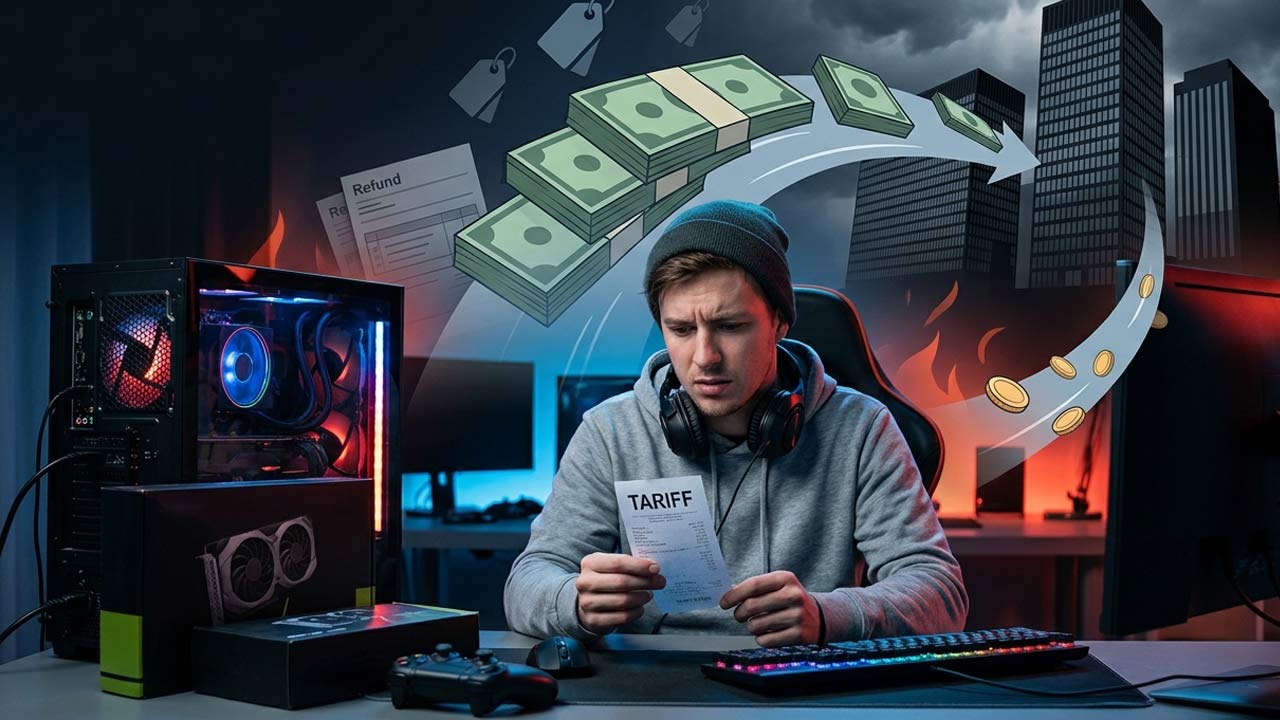
The U.S. government’s tariff refund program has become one of the biggest stories right now.
With billions of dollars being returned to companies after the Supreme Court ruled that many tariffs imposed under the International Emergency Economic Powers Act (IEEPA) were unlawful.
As companies begin receiving refunds, many gamers are asking a simple question: Will this finally make gaming hardware cheaper?
The short answer is yes, but only in certain situations.
While tariff refunds could reduce prices on gaming PCs, graphics cards, gaming monitors, accessories, and even consoles in some cases, the benefits won’t be evenly distributed.
Whether gamers actually save money depends entirely on how each company chooses to use its refund.
What Are Tariff Refunds?
Earlier this year, the U.S. Supreme Court ruled that many of the broad IEEPA tariffs introduced during President Donald Trump’s administration exceeded presidential authority.
The decision required the U.S. government to begin returning billions of dollars collected from importers. Since then, U.S. Customs has been processing refunds worth well over $100 billion, with payments continuing throughout 2026.
However, it is important to understand that these refunds are paid to importers, not consumers.
Companies that imported products into the United States receive the money back, and they are under no general legal obligation to pass those savings on to customers.
That distinction is what makes the impact on gamers uncertain.
How Tariffs Affected Gaming Products
The gaming industry was among the sectors hit hardest by the tariff increases because most gaming hardware is manufactured in Asia.
The following gaming products were impacted:
- Gaming consoles
- Graphics cards
- Gaming laptops
- PC components
- Gaming monitors
- Controllers and accessories
- Storage devices
Companies such as Nintendo, Sony, Microsoft, AMD, NVIDIA, ASUS, MSI, Gigabyte, Razer, Corsair, Logitech, and countless PC component manufacturers either absorbed additional costs or passed them to consumers through higher prices.
Nintendo became one of the most visible examples after delaying U.S. Switch 2 pre-orders in 2025 while evaluating the impact of tariffs.
The company later sued the U.S. government seeking refunds for tariffs it had paid on imported products.
Gamers Already Paid the Price
For many gamers, the biggest issue isn’t whether companies are receiving tariff refunds; it’s the fact that consumers already paid for those tariffs in the first place.
When the tariffs were introduced, numerous gaming hardware manufacturers and retailers warned that the additional import costs would force them to raise prices.
Graphics cards, gaming laptops, monitors, accessories, handheld gaming PCs, and even some consoles became more expensive, with companies frequently citing tariffs as one of the main reasons for the increases.
Whether the extra cost appeared as a separate surcharge or was quietly built into the retail price, gamers ultimately bore much of the financial burden.
Now that the U.S. government is refunding billions of dollars in tariffs to importers, many consumers are questioning why they are not automatically receiving any of that money back.
From a consumer’s perspective, the logic is simple: if customers were expected to absorb the higher costs when tariffs were imposed, shouldn’t they also benefit when those same tariffs are refunded?
Legally, the answer is generally no. Tariff refunds are paid to the importer of record rather than the end customer, and there is no broad legal requirement forcing companies to reimburse customers or lower prices after receiving those funds.
However, from an ethical and customer relations standpoint, many gamers believe the companies that justified higher prices because of tariffs should now consider sharing those refunded savings with the customers who ultimately financed them.
Companies Passing Tariff Refunds Back to Customers
So far, Amazon is one of the few major companies to publicly announce that at least some customers will benefit from tariff refunds.
During its second-quarter 2026 earnings call, Amazon confirmed it had received approximately $600 million in tariff refunds.
Chief Financial Officer Brian Olsavsky said the company has identified situations where tariff-related import charges were directly passed on to customers.
In those cases, Amazon will automatically contact affected customers and issue refunds without requiring them to file a claim.
For situations where refunds cannot be directly linked to specific purchases, Amazon says the money will instead be used to continue investing in lower prices for customers.
Although Amazon’s announcement applies to only a limited number of purchases, it has set a benchmark that many consumers now expect other retailers and gaming hardware companies to follow.
Companies That Have Not Committed to Refunding Gamers
While Amazon has announced a customer refund program, most major gaming companies have remained silent on whether they will pass tariff refunds back to consumers.
Nintendo is perhaps the most notable example. The company is seeking to recover millions of dollars in tariffs paid on products imported into the United States, arguing that the duties were unlawfully collected.
At the same time, Nintendo is asking a U.S. court to dismiss a class-action lawsuit filed by customers seeking reimbursement for alleged tariff-related overcharges.
In its court filings, Nintendo argues that customers are not legally entitled to refunds because the prices they paid reflected the agreed purchase price, which was based on numerous business factors beyond tariffs alone.
Other major gaming companies, including Sony Interactive Entertainment, Microsoft, NVIDIA, AMD, ASUS, MSI, Gigabyte, Razer, Corsair, Logitech, Best Buy, Walmart, and GameStop, have not announced any plans to issue customer refunds related to tariff repayments.
Among them, Logitech has confirmed receiving a $61 million tariff refund, which contributed to stronger quarterly earnings.
However, the company has not announced any consumer refund program or tariff rebate for customers purchasing Logitech gaming mice, keyboards, headsets, or other peripherals.
Similarly, retailers such as Walmart and Home Depot have applied for tariff refunds but have not pledged to return those funds directly to customers.
That does not necessarily mean these companies are keeping the money as additional profit.
Some businesses may use the refunds to recover losses incurred during the tariff period, strengthen their supply chains, or invest in future products.
Others may eventually pass the savings on through lower prices or promotions. However, as of now, none of these companies have publicly committed to returning tariff refunds directly to gamers or other consumers.
This distinction is likely to become increasingly important for gamers.
Many companies justified higher prices by citing tariffs when they were introduced.
Now that those same tariffs are being refunded, consumers will be watching closely to see which brands choose to share those savings and which continue charging the same prices despite recovering part of their import costs.
Where Gamers Could Actually Save Money
PC gaming hardware is likely to see the biggest indirect benefit from tariff refunds.
Many PC manufacturers import components directly into the United States, and if those companies receive significant refunds, they could choose to lower retail prices, introduce larger promotional discounts, offer cashback deals, or simply improve their profit margins while keeping prices stable.
Because the PC hardware market is extremely competitive, manufacturers often compete aggressively on pricing to attract buyers.
That competition increases the chances that at least part of the refund will eventually reach consumers.
Graphics cards from AMD and NVIDIA’s board partners, along with gaming motherboards, SSDs, RAM, power supplies, gaming monitors, and other peripherals, could all become more competitively priced during future sales events.
Consoles May Not Become Cheaper
Console pricing is a completely different story.
Unlike PC hardware, console manufacturers typically operate on carefully planned global pricing strategies and rarely change a console’s MSRP during its lifecycle unless absolutely necessary.
Even if Nintendo, Sony, or Microsoft receive substantial tariff refunds, there is no guarantee they will reduce console prices.
Instead, the additional funds are more likely to be used to recover previous losses, improve profit margins, expand marketing efforts, or create more attractive bundles that include games or accessories.
As a result, gamers are more likely to see better value through bundled offers than permanent price reductions.
Accessories Have Better Odds
Gaming accessories represent one category where consumers may notice changes more quickly.
Products such as gaming mice, mechanical keyboards, controllers, headsets, webcams, capture cards, and gaming chairs are sold in highly competitive markets where numerous brands compete for customers.
If manufacturers receive significant tariff refunds, they may choose to pass some of those savings to consumers through deeper discounts and more aggressive promotions, particularly during major shopping events such as Black Friday, Cyber Monday, Prime Day, and the holiday season.
Why Prices May Not Fall Immediately
Many gamers expect tariff refunds to instantly reduce prices, but economics rarely works that way.
Companies have already spent years dealing with higher shipping costs, supply chain adjustments, increased warehousing expenses, long-term manufacturing contracts, and inventory that was purchased months before reaching retail shelves.
Even after receiving refunds, many businesses may decide to recover those earlier losses rather than immediately lowering prices for consumers.
Additionally, not every tariff has disappeared. Several import duties imposed under other legal authorities, including Section 301 and Section 232 tariffs, remain in effect.
As a result, many gaming products continue to face additional import costs despite the Supreme Court ruling.
Competition Will Decide Everything
The biggest factor determining whether gamers benefit isn’t the refund itself; it’s competition.
If one manufacturer decides to lower prices after receiving a refund, competing brands are often forced to respond with similar discounts or better promotional offers.
A single company reducing the price of a gaming monitor, for example, could trigger competing brands to match that discount, prompting retailers to introduce additional bundle deals or promotional offers.
This competitive environment is especially common in the gaming PC market, where dozens of manufacturers sell similar hardware.
The more competitive a product category is, the greater the likelihood that consumers will eventually benefit from tariff refunds through lower prices or better deals.
Digital Games Won’t Change Much
Gamers hoping for cheaper digital games are likely to be disappointed.
Digital purchases from platforms such as Steam, the PlayStation Store, Xbox Store, Nintendo eShop, and the Epic Games Store aren’t directly affected by import tariffs because no physical goods cross U.S. borders.
Publishers set digital prices based on market demand, platform fees, exchange rates, and regional pricing, not import duties.
As a result, tariff refunds are unlikely to affect digital game pricing.
The Biggest Winners Could Be PC Builders
DIY PC builders may ultimately gain the most from tariff refunds.
Unlike console ecosystems, PC hardware consists of components sourced from many competing manufacturers.
If SSD prices fall slightly, motherboard discounts improve, RAM becomes cheaper, and GPU promotions become more frequent, the combined savings can significantly reduce the cost of building a gaming PC.
Even modest price reductions across several components can make a noticeable difference.
Final Thoughts
Tariff refunds are undoubtedly good news for the gaming industry, but whether they become good news for gamers is an entirely different question.
The companies receiving these refunds are, in many cases, the same companies that previously cited tariffs as a reason for raising prices on gaming hardware.
Gamers ultimately absorbed much of those additional costs when buying consoles, graphics cards, gaming laptops, monitors, and accessories.
Now that billions of dollars in tariffs are being refunded to importers, consumers naturally expect some of those savings to flow back to them.
Ultimately, the biggest question is no longer whether companies will receive tariff refunds; they already are.
The real question is which gaming companies will share those savings with the gamers who paid higher prices because of the tariffs.
As more refunds are distributed throughout 2026, gamers will be watching closely.
Companies that offer lower prices, rebates, or better promotions are likely to earn significant goodwill, while those that retain the refunds without passing on any meaningful benefit may face increasing scrutiny from gamers who believe they already paid the bill.